




Variable Frequency Drives (VFDs) are powerful tools for saving energy and controlling motors. But in regions like Africa and South Asia — where power grids are unstable, and voltage can change without warning — VFDs can create serious electrical problems if not properly managed.
This article explains two important topics in simple language:
- How VFDs affect power quality through harmonics and power factor
- How to protect your VFD system from overcurrent faults
We also explain how the MINGCH MC9001 VFD is built to work reliably in harsh electrical environments.

1. What Are VFD Harmonics and Why Do They Matter?
When a VFD converts AC power to DC and back to AC, it does not draw a smooth, clean current. Instead, it pulls current in short, sharp bursts. These bursts create extra electrical waves called harmonics.
| Simple Explanation: Think of clean power as a smooth river. Harmonics are like rocks thrown into the river — they create ripples that disturb the flow and can damage nearby equipment. |
Why Harmonics Are a Bigger Problem in Africa and South Asia
In regions with weak power grids, VFD harmonics make the situation worse because:
- Weak grids cannot absorb electrical disturbances easily
- Many factories share one transformer, so one VFD affects all equipment on the same power line
- Old wiring and poor infrastructure increase harmonic amplification
- Harmonic distortion causes overheating in transformers, motors, and cables
Total Harmonic Distortion (THD) measures how much harmonic interference exists. A healthy VFD system should keep THD below 5%.
| Harmonic Level (THD) | Effect on System |
| Below 5% | Safe — minimal equipment stress |
| 5% to 10% | Slight overheating, reduced efficiency |
| 10% to 20% | Equipment damage, tripped breakers |
| Above 20% | Serious damage, risk of system failure |
2. What Is a VFD Harmonic Filter and When Do You Need One?
A VFD harmonic filter is a device added to the VFD system to reduce harmonic disturbances. There are two main types:
- Passive Harmonic Filter — Uses inductors and capacitors to block certain harmonic frequencies. Simple, low cost, and suitable for most industrial applications.
- Active Harmonic Filter — Uses electronics to detect and cancel harmonics in real time. More effective but more expensive.
For buyers in Africa and South Asia operating multiple VFDs in one facility, combining passive filters on each drive with a shared active filter at the main panel is usually the best approach.
| MC9001 Built-in Advantage: The MINGCH MC9001 VFD includes a built-in DC reactor that reduces input current harmonics by up to 40% — without any extra filter hardware. This lowers your installation cost and protects your grid automatically. |
3. Does a VFD Improve the Power Factor?
Power factor measures how efficiently your electrical system uses energy. A perfect power factor is 1.0. Most industrial systems run between 0.7 and 0.9.
Standard VFDs without correction typically lower the power factor to around 0.6 to 0.75 because they draw current in an uneven pattern.
How the MC9001 Improves Power Factor
The MC9001 is designed with built-in power factor correction features:
- The integrated DC reactor smooths the input current draw, reducing reactive power waste
- Variable speed operation lets the motor run efficiently at all load levels, not just full speed
- An optional built-in EMC filter reduces the distortion that pulls the power factor down
With the MC9001, users in unstable grid environments regularly achieve a power factor of 0.93 to 0.98 — a major improvement that reduces electricity bills and prevents penalty charges from power utilities.
| VFD Efficiency Bonus: Better power factor means less wasted energy. In regions where electricity is expensive or unreliable, a VFD with good power factor correction can pay for itself in 12 to 18 months through energy savings alone. |
4. Overcurrent Fault on VFD: Causes, Meaning, and Fixes
One of the most common problems VFD operators face is an overcurrent fault. This is a safety signal that tells you the drive has detected more electrical current than it can safely handle.
Common Causes of VFD Overcurrent Faults
| Cause | Explanation |
| Acceleration too fast | Motor asked to speed up before it is ready |
| Overloaded motor | Motor pulling more current than its rated capacity |
| The motor is asked to speed up before it is ready | Damaged cable creating a direct current path |
| Grid voltage sag | Power supply drops suddenly, causing a current spike |
| Wrong motor parameters | VFD settings do not match the connected motor |
| Faulty VFD components | Internal IGBT or capacitor failure |
How to Troubleshoot an Overcurrent Fault — Step by Step
- Check the VFD display for the exact fault code. The MC9001 shows detailed codes: OC1 (acceleration), OC2 (deceleration), OC3 (constant speed).
- Increase the acceleration time (ramp-up time). Many startup overcurrent faults are simply caused by trying to start the motor too fast.
- Verify the motor current rating matches the VFD capacity.
- Inspect all cables between the VFD and motor for damage, moisture, or loose connections.
- Check input voltage. In Africa and South Asia, grid voltage can drop 15 to 20%. The MC9001 operates normally within 320 to 460V AC, giving wide voltage tolerance.
- Run the VFD auto-tuning function so the drive can learn the motor’s actual electrical characteristics.
5. How to Size Overcurrent Protection for a VFD
Correct overcurrent protection prevents fires and equipment damage. The sizing rules for VFDs are different from standard motor starters.
Basic Sizing Rule
Use an inverse time-delay fuse or circuit breaker rated at 150% to 175% of the VFD’s input current rating — not the motor’s full load current.
| Example: If the MC9001 VFD is 11kW (15HP) with an input current of 25A, use a 35 to 45A time-delay fuse or circuit breaker at the input. Do not use a fast-blow fuse. |
Additional Protection Tips for Unstable Grids
- Install a surge protection device (SPD) at the input panel — lightning and voltage spikes are common in tropical regions
- Use a 3-phase voltage monitoring relay to disconnect the VFD if the voltage leaves the safe operating range
- The MC9001 includes built-in protections: overvoltage, undervoltage, overtemperature, and ground fault detection
- For remote sites with long cable runs (common in mining and farming in Africa), install output reactors to prevent reflected wave damage
MINGCH MC9001: Power Assurance for Harsh Environments
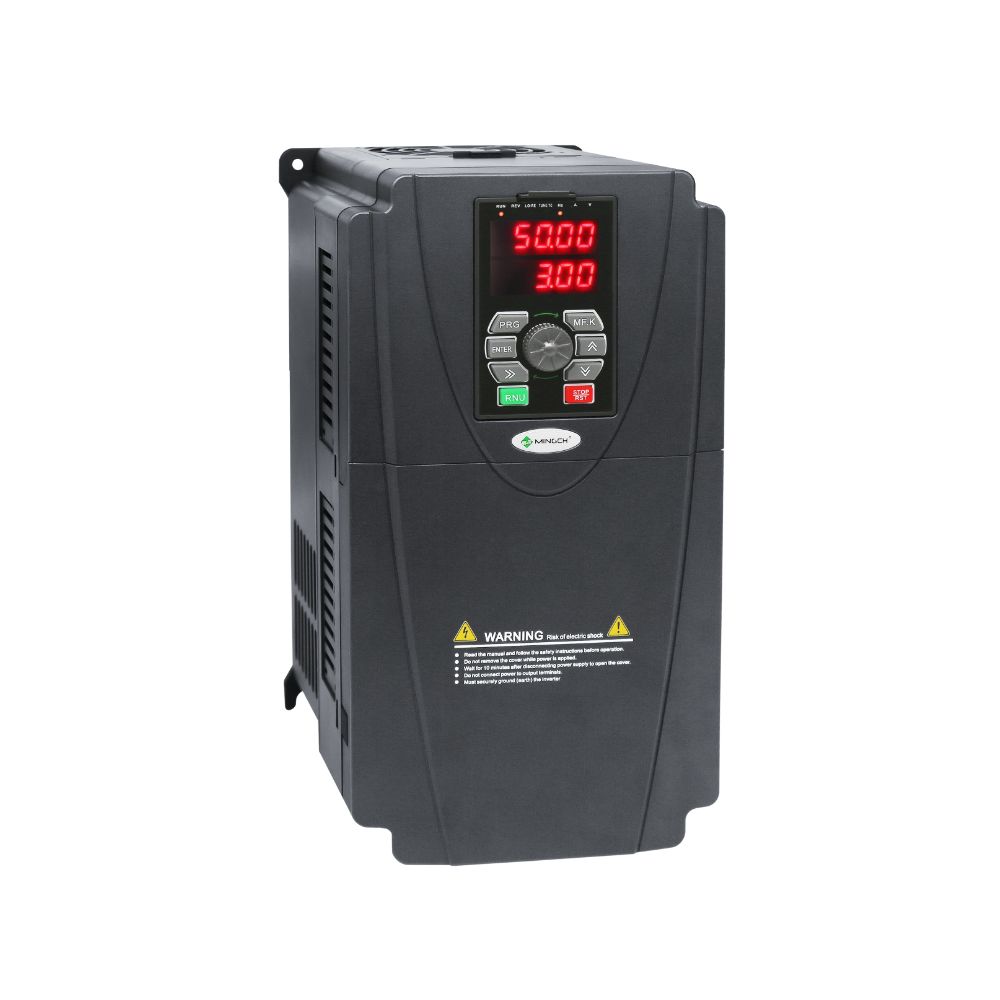
MINGCH has extensive experience supplying VFDs to markets with difficult power conditions. The MC9001 was specifically designed with these environments in mind.
| MC9001 Feature | Benefit for Unstable Grid Regions |
| Wide voltage input: 320 to 460V | Works even when grid voltage drops significantly |
| Built-in DC reactor | Reduces harmonics by 40%, protects other equipment |
| Input phase loss protection | Prevents damage when one phase of 3-phase power fails |
| Real-time fault logging | Easy troubleshooting for local technicians |
| Auto-restart after power recovery | Reduces downtime after brief power outages |
| IP55 optional enclosure | Protection against dust and humidity in tropical climates |
| CE, ISO 9001 certified | Meets international quality and safety standards |
Conclusion
Discover MINGCH Manufacturing Excellence
Step inside our factory to see how high-quality voltage regulators and inverters are engineered for precision and durability.
Explore Our FactoryBusinesses in Africa, South Asia, and other regions with unstable power need proper VFD harmonics control. Overcurrent protection isn’t optional. It’s essential.
By choosing a VFD like the MINGCH MC9001, which includes built-in harmonic reduction, wide voltage tolerance, and comprehensive fault protection, you can:
- Reduce energy costs through improved power factor and VFD efficiency
- Protect your equipment from grid-related damage
- Minimize downtime caused by overcurrent faults
- Meet local power quality regulations

MINGCH offers technical support, local commissioning guidance, and OEM/ODM options for overseas buyers who need a reliable, long-term power solution.
Frequently Asked Questions (FAQs)
Q: What is VFD harmonic distortion?
A: When a VFD runs, it creates electrical “noise” that travels through your power line. This noise disturbs other machines connected nearby — causing them to overheat, behave erratically, or fail early. If your grid is already weak, this problem gets worse fast.
Q: Does a VFD improve power factor?
A: Not always. A basic VFD can actually make the power factor worse. But the MC9001 is different. Its built-in DC reactor cleans up how it draws power, pushing power factor to 0.93–0.98. That means lower electricity bills and no penalty charges from your utility.
Q: What causes an overcurrent fault on a VFD?
A: Usually one of these: the motor is accelerating too quickly, the load is too heavy, a cable is damaged, or the grid voltage has dropped. Always start by checking the fault code on the VFD screen. It shows exactly where to look.
Q: How do I fix an overcurrent fault on a VFD?
A: Start simple. Slow down the acceleration time. Then check that your motor settings match the VFD, inspect cables for damage, and confirm your input voltage is stable. If it still trips, run the VFD’s auto-tuning so it can properly learn your motor.
Q: Do I need a harmonic filter with a VFD?
A: If several VFDs share one transformer — or your local grid is unreliable — yes, you really should have one. The good news: the MC9001 already has a built-in DC reactor that cuts harmonics by up to 40%, so you may need less external filtering.
Q: How do I size overcurrent protection for a VFD?
A: Always size based on the VFD’s input current, not what’s written on the motor nameplate. A good rule: use a time-delay fuse or breaker at 150–175% of input current. For an 11kW MC9001 drawing 25A, that means a 35–45A time-delay breaker.
Q: Is the MC9001 suitable for areas with unstable voltage?
A: Yes. It was built with exactly that in mind. It handles input voltage anywhere from 320 to 460V AC, so even when your grid dips or surges, the drive keeps running. It also has built-in protection for phase loss, overtemperature, and voltage extremes.


