




For applications with frequent starting, stopping, or heavy regenerative loads — cranes, hoists, conveyors, high-inertia machinery — two components are critical alongside the drive: the braking resistor and the line reactor. This guide explains what each does, how to size them correctly, and how to configure the MC9001 for reliable operation.

Why Braking Resistors Are Needed
When a VFD decelerates a motor faster than the load naturally slows down, the motor switches into generator mode. That energy flows back into the drive’s DC bus, raising the voltage. If it exceeds the overvoltage threshold — around 800V on a 380V system — the drive trips.
A braking resistor gives that energy a controlled path out. It dissipates it as heat, keeps the DC bus stable, and allows faster, smoother deceleration.
Cranes, hoists, and other overhauling loads regenerate energy continuously. This does not happen only when stopping. It occurs throughout the operation. Because of this, a braking resistor is not optional. It is essential for safe and stable performance.
How Dynamic Braking Works on the MC9001
The MC9001 includes a built-in braking chopper for models up to 18.5 kW. Larger models require an external braking unit. The chopper monitors DC bus voltage and switches the braking resistor in when it exceeds the threshold set in parameter F3.10 (default: 760V for a 380V supply).
The resistor absorbs energy until the bus voltage drops, then the chopper switches off. This cycle repeats throughout deceleration. The result is a stable DC bus and controlled, fault-free stopping.

Selecting the Correct Braking Resistor
Resistance Value
Too low and you destroy the chopper IGBT. Too high and braking torque is insufficient. Use this formula for minimum resistance:
R_min = V²_DC ÷ (P_motor × 1.3)
| Drive Rating | Min. Resistance (Ω) | Recommended (Ω) | Min. Power (kW) |
| 2.2 kW | 100 Ω | 100–120 Ω | 2.2 kW |
| 4.0 kW | 60 Ω | 60–75 Ω | 4.0 kW |
| 7.5 kW | 30 Ω | 30–40 Ω | 7.5 kW |
| 11 kW | 20 Ω | 20–25 Ω | 11 kW |
| 15 kW | 15 Ω | 15–20 Ω | 15 kW |
| 18.5 kW | 13 Ω | 13–18 Ω | 18.5 kW |
Power Rating and Duty Cycle
The resistor wattage depends on how long it is active. Use: P_resistor = P_motor × Duty Cycle (%).
| Application | Typical Duty Cycle | Sizing Basis |
| Crane/hoist | 100% | Full motor rated power |
| Frequent stop-start conveyor | 30–60% | Motor power × duty cycle |
| Occasional emergency stop | 5–10% | Motor power × duty cycle |
| CRANE RULE | Always size for 100% duty cycle. The motor regenerates continuously during lowering — not just on stops. |
Line Reactors: Input and Output Protection
AC Input Reactor
A VFD draws current in high-amplitude pulses, injecting harmonics into the supply network. A 3% AC line reactor smooths this current, reduces harmonic distortion, limits inrush on power-up, and protects the drive from supply transients.
Use one when: multiple drives share a panel, sensitive equipment is on the same circuit, or the supply transformer is large, and the grid impedance is low.
Output Reactor: Long Cable Runs
PWM voltage pulses reflect at the motor terminals on long cable runs, potentially doubling peak voltage to ~1,000V. This degrades motor winding insulation over time.
| Cable Length | Risk | Protection | Notes |
| < 50 m | Low | None required | Standard cable adequate |
| 50–100 m | Medium | 3% output reactor | Limits the voltage rise rate |
| 100–200 m | High | dV/dt filter | Limits voltage rise rate |
| > 200 m | Very High | Sine filter | Full sinusoidal output |
Complete Power System Support from MINGCH
Discover MINGCH Manufacturing Excellence
Step inside our factory to see how high-quality voltage regulators and inverters are engineered for precision and durability.
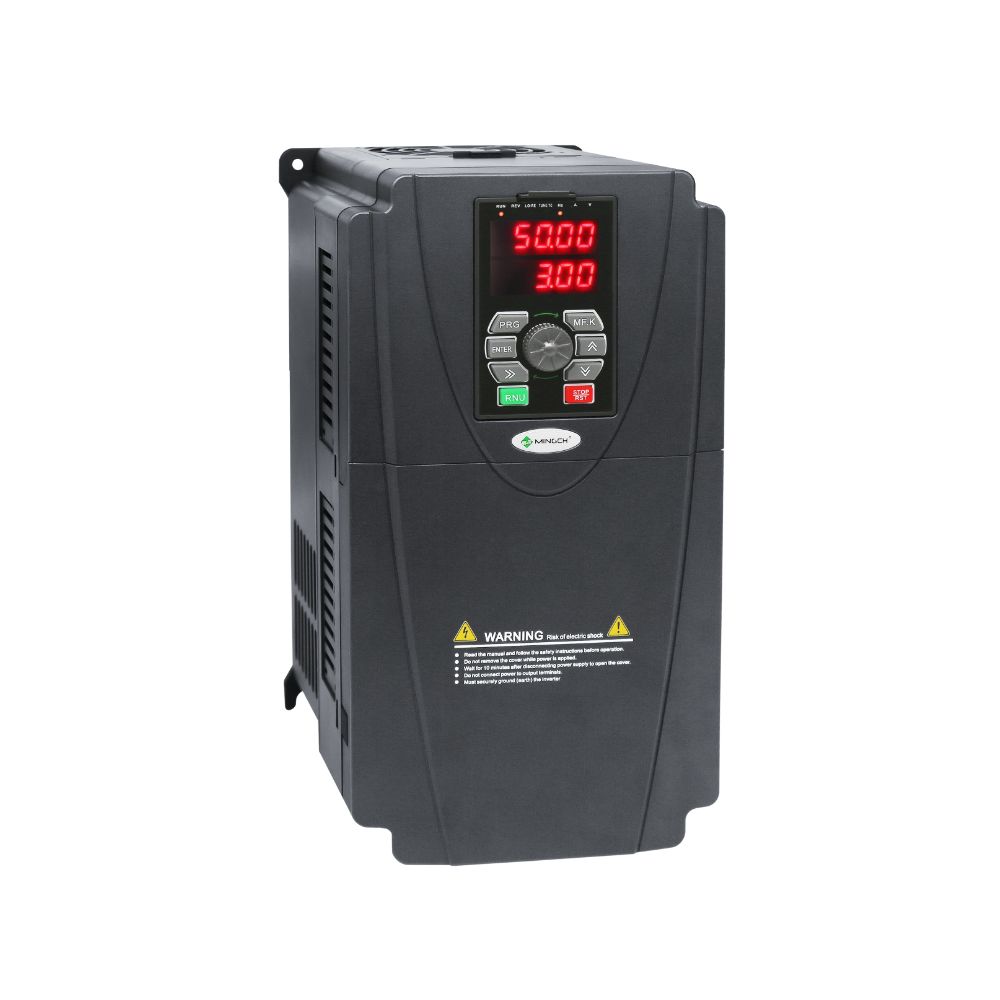
Explore Our FactoryMINGCH supplies the MC9001 together with matched braking resistor assemblies, AC line reactors, and output filters — all pre-verified for compatibility. Ordering a complete kit simplifies commissioning and removes component sizing risk. This single-source approach is particularly valuable for trading companies and system integrators managing multiple installations.
Power your entire VFD system with confidence. MINGCH delivers the MC9001 alongside perfectly matched components like braking resistors, line reactors, and output filters—all supported by expert engineering from selection to commissioning.
Stop troubleshooting and start running. Visit www.mingchele.com to get the right solution, fast.
Frequently Asked Questions
Do I always need a braking resistor?
No. Low-inertia loads with slow deceleration rarely cause OV faults. But cranes, hoists, high-inertia loads, and frequent stop-start applications require one.
What happens if the resistor overheats?
It fails open-circuit, removing the braking path and causing OV trips. In severe cases, it is a fire risk. Always fit a thermal switch wired to a drive fault input.
Can I use a third-party resistor?
Yes, provided resistance and power rating meet MC9001 minimums. MINGCH matched assemblies are pre-verified and simplify commissioning.
What is the difference between a 3% and 5% line reactor?
A 5% reactor gives more harmonic reduction but introduces a larger voltage drop. For most applications, 3% is the right balance.
My drive keeps tripping OV during deceleration. What should I check?
Verify the braking resistor is connected and within the correct resistance range. Check that F3.10 is set correctly. Try increasing the deceleration ramp time.
Can one braking resistor serve multiple drives?
No. Each drive has its own braking chopper and terminals. Sharing a resistor risks unequal current distribution and damage to braking circuits.
Is a line reactor the same as an EMC filter?
No. A line reactor reduces low-order current harmonics and inrush. An EMC filter attenuates high-frequency emissions. They serve different purposes.
Does an output reactor affect motor performance?
A correctly sized 3% reactor has a negligible effect on speed or torque. Monitor motor terminal voltage on very long cable runs to confirm adequate performance.


