




It means confirming the drive can talk to the rest of the plant over the same communication protocol. This guide covers both the electrical sizing and the digital interfaces that tie a drive into a modern automation network.
How Do You Match a Variable Frequency Drive to an AC Motor’s Power Rating?

Power rating is the starting point for any variable frequency drive AC motor pairing, but current matters more than the horsepower label. Two motors with the same power rating can carry different full-load amperage figures depending on design and efficiency class. Sizing to current, not just kilowatts, avoids an undersized drive later.
Reading the Motor Nameplate First
Pull the voltage, full-load amperage, and service factor straight from the motor nameplate before comparing drives. These three figures matter more than the horsepower rating printed at the top.
Service factor shows how far a motor can run above its rated load without damage, typically between 1.0 and 1.15. A motor rated at 1.15 draws extra current at that higher load, so the drive needs matching headroom.
When sizing a variable frequency drive for AC motor applications, engineers should compare the drive’s rated output current with the motor’s full-load amperage. Sizing based on horsepower alone risks an undersized drive that trips on overcurrent. Two 10kW motors from different manufacturers can carry full-load amperage figures that differ by 10 percent or more.
Overload Margins for Variable and Constant Torque Loads
Fans and pumps typically need lighter overload margins since torque drops with speed. Conveyors, mixers, and other constant-torque loads need heavier overload capacity, often rated for 150 percent of current for 60 seconds. Choosing the wrong margin can mean nuisance trips during startup or under sudden load spikes.
What Communication Interfaces Do Modern AC Motor VFDs Support?
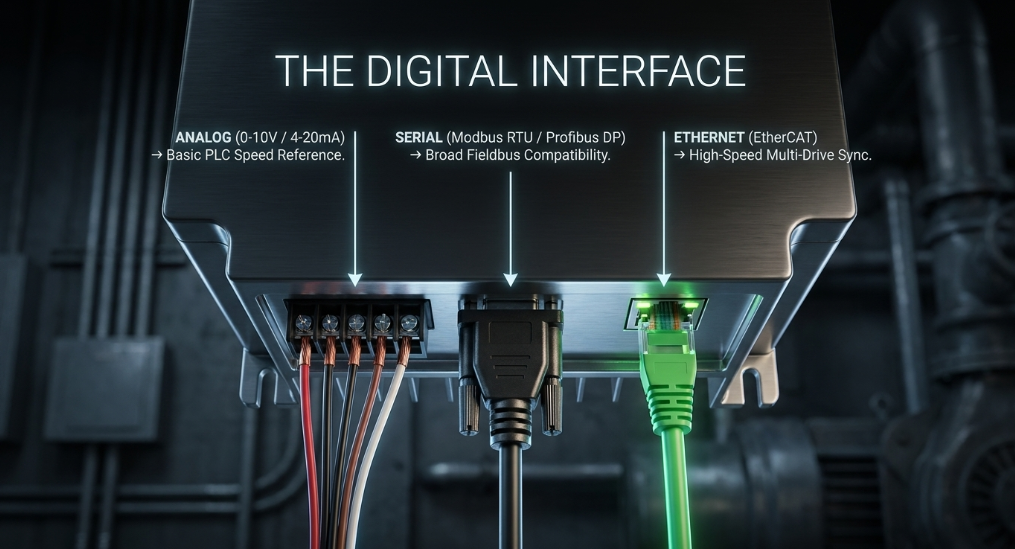
An electric motor variable frequency drive rarely runs in isolation on a modern line. Most installations need the drive to report status and accept speed commands from a central controller.
Analog Signals: 4-20mA and 0-10V
The simplest interface uses analog signals, typically 4-20mA current loops or 0-10V voltage signals. These set a speed reference from a PLC or a process controller. This approach remains common on simpler installations where a full fieldbus network is not justified. It is also easy to troubleshoot with a basic multimeter.
Serial and Fieldbus Protocols: Modbus and Profibus
Modbus RTU over RS-485 is the most widely supported serial protocol for an AC motor variable frequency drive. It is prized for its simplicity and broad compatibility. Profibus DP remains common on older plant standards and mid-speed, deterministic drive networks.
For the wiring side of this setup, see our guide to connecting and integrating a VFD with a PLC system.
Ethernet-Based Protocols: EtherCAT and Plant-Wide Networks
EtherCAT and similar Ethernet-based protocols move data at much higher speeds, supporting real-time monitoring across dozens of drives on one network. Smart factory upgrades typically standardize on one Ethernet protocol across PLCs, drives, and robots to simplify wiring and diagnostics.
How Does a VFD Fit Into an IIoT-Enabled Smart Factory?
Industrial Internet of Things platforms depend on getting clean, structured data out of field devices. Drives are one of the richest sources on the plant floor. A single VFD can expose dozens of live parameters, from output frequency to bus voltage, without any extra sensors.
The VFD’s Role Inside the Automation Network
A modern drive reports current, temperature, fault history, and running hours continuously over its communication port. This turns a single VFD into a live sensor for the motor and the load it drives, not just a speed controller. Functional safety features such as Safe Torque Off often ride on the same network connection.
PLC and SCADA Compatibility in Practice
Senior engineers planning smart factory upgrades check communication compatibility between drives and PLC or SCADA systems before finalizing a bill of materials. Before purchasing a variable frequency drive for AC motor projects, confirm that its communication protocol matches the existing control network. A drive that only supports an outdated protocol can force a costly gateway device or a wider network redesign later.
Our guide to motor control centers and VFD integration covers how these networked drives sit inside a larger panel design.
Why Do Engineers Choose MINGCH VFDs for AC Motor Projects?
MINGCH Electrical builds its variable frequency drive for the AC motor lineup with 4-20mA, 0-10V, and serial ports as standard. Modbus, Profibus-DP, and EtherCAT support come standard too. This lets one drive platform fit both a simple standalone fan and a fully networked line inside a smart factory.
Every unit carries CE-LVD certification and is built in an ISO9001 factory, with an in-house R&D team available for custom communication configurations. Explore the full AC motor VFD range to match interfaces to your control architecture. You can also download the product catalog for wiring and protocol details.

Frequently Asked Questions
What Information Do I Need Before Selecting a VFD for an AC Motor?
Pull the voltage, full-load amperage, and service factor from the motor nameplate. Also confirm the load type, since variable-torque fans and pumps need different overload margins than constant-torque conveyors or mixers. Communication needs matter too.
Can a VFD Communicate Directly With a PLC?
Yes. Most modern drives support Modbus, Profibus, or Ethernet-based protocols like EtherCAT, letting a PLC set speed and read status directly. This removes the need for separate analog wiring for every drive.
Is Modbus or EtherCAT Better for a New Installation?
Modbus suits simple monitoring and legacy integration over serial or basic Ethernet. EtherCAT suits high-speed, multi-drive networks needing tight synchronization, such as coordinated motion or large fan and pump groups.
Do All AC Motor VFDs Support Analog Speed Control?
Most industrial drives, including MINGCH’s AC motor range, include 4-20mA and 0-10V analog inputs as standard alongside digital communication ports. This keeps simple installations straightforward while still allowing a network upgrade later.


