




This guide explains what an air conditioner voltage regulator does, why tropical markets often need one, and how to choose the right size for home use. It also shows how MINGCH Electrical supports stable cooling with an ultra-wide 45V–270V input range and in-house toroidal transformer production.
Why Does an AC Voltage Regulator Matter?
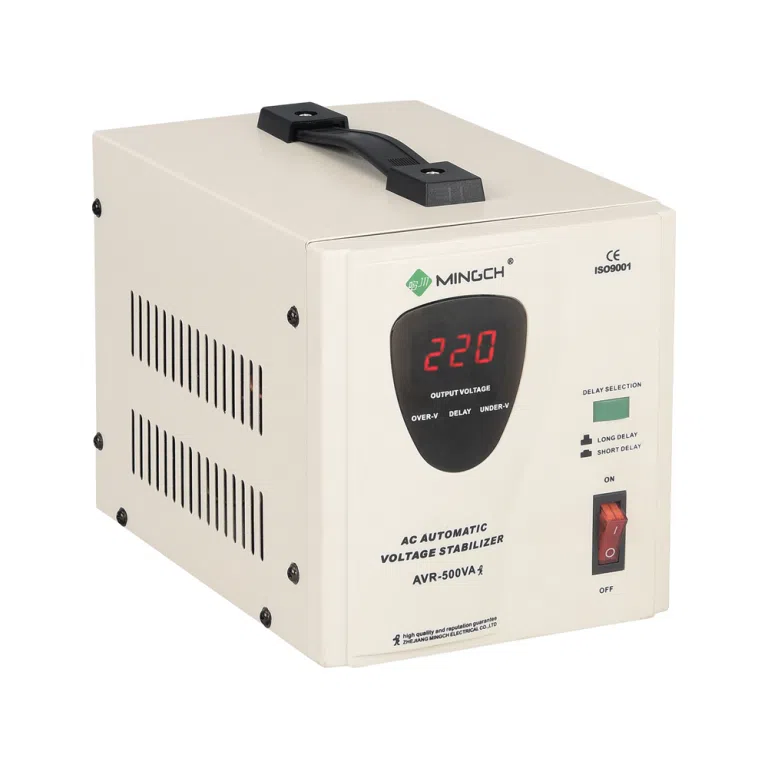
An AC voltage regulator is an automatic voltage stabilizer that helps an AC get safer power. When voltage goes too low or too high, the compressor, motor, and control board can suffer. A good air conditioner stabilizer keeps the voltage in a better range, so cooling stays steady and parts last longer.
In simple words, it helps the AC start, run, and cool the way it should. A voltage stabilizer for air conditioner use is especially helpful in places where power is weak, jumps often, or changes during the day.
Why Do Tropical Markets Need Stronger Voltage Protection?
In South America and Southeast Asia, heat is high and AC use is heavy. At the same time, power can drop at night, surge in the afternoon, or swing during storms. That is why an air conditioner with stabilizer is common in many homes and small businesses.
| Power problem | What can happen to the AC | Why protection matters |
| Low voltage | Hard starting, weak cooling, heat build-up | Helps protect the compressor |
| High voltage | PCB or motor damage | Helps prevent burn-out |
| Fast voltage swings | Unstable running | Helps keep cooling steady |
| Surges | Sudden failure risk | Helps reduce repair costs |
A strong automatic voltage stabilizer helps the AC work more safely in these hot and humid markets.

How Does MINGCH Handle a 45V–270V Input Range?
MINGCH Electrical builds products for hard power conditions. Its auto voltage stabilizer range supports an ultra-wide 45V–270V input voltage range. That matters in places where the grid is not stable and normal household voltage can move far from the target level.
This wide range helps a voltage stabilizer for air conditioner use keep the output more stable, even when input power is poor. For homes, shops, and small offices, it means the AC can keep running with less stress and fewer sudden stops.
Why Does In-House Transformer Production Improve Stabilizer Quality?
The transformer is the core part of a stabilizer. MINGCH makes its own toroidal transformer in-house, which gives tighter quality control from material to final test. This is important because the transformer has a big effect on voltage control, heat rise, efficiency, and long-term life.
For the buyer, this means each automatic voltage stabilizer is built with better process control. It also helps MINGCH keep product quality more consistent across different models. When an air conditioner with stabilizer is used every day in hot weather, stable internal quality matters.
How Should You Size a Home AC Stabilizer?
For household air conditioners, use a simple rule: AC rated power × 3. This helps cover the higher starting current when the compressor turns on.
What Does the Power Times Three Rule Mean?
Many AC units draw more power at startup than during normal running. If the stabilizer is too small, it may trip, overheat, or fail to protect the unit well. That is why MINGCH recommends sizing the air conditioner stabilizer at about three times the AC rated power.
Which Home Size Works for Common AC Loads?
| AC rated power | Multiply by three | Suggested stabilizer size |
| 800W | 2400W | 3 kVA |
| 1000W | 3000W | 3 kVA |
| 1500W | 4500W | 5 kVA |
This simple method makes it easier to choose an AC voltage regulator for home use.
What Should You Check Before Buying One Today?
Before buying a voltage stabilizer, keep these key points in mind:
- Input range: In areas with unstable power, a wider input range offers better protection.
- Build quality and safety functions: Check for overvoltage, undervoltage, overload, and overheat protection.
- Product fit: Match the stabilizer to the AC capacity and local power conditions.
A good voltage stabilizer for air conditioner use should be easy to install, fit the load, and perform well in hot climates. In many homes, an air conditioner with stabilizer is not a luxury. It is a practical way to reduce damage risk and keep cooling reliable.
Why Choose MINGCH for AC Voltage Protection Today?
For tropical markets, MINGCH Electrical offers a practical answer. Its AC voltage regulator solutions support a wide 45V–270V input range, which is useful in South America and Southeast Asia where voltage can swing hard. MINGCH also makes the core toroidal transformer in-house, which improves quality control and product consistency.
That gives buyers a stronger automatic voltage stabilizer, a dependable auto voltage stabilizer option for daily use, and a clear sizing rule for home systems: AC power × 3. For better protection, steadier cooling, and more confident product quality, MINGCH is a smart choice for air conditioner stabilizer needs.
FAQS (Frequently Asked Question)
- What are AC voltage regulators?
AC voltage regulators are devices that keep AC voltage at a steady level. They help when the input power goes up or down. By holding the voltage closer to the right value, they protect equipment and help machines run better. You can find them in homes, factories, and control systems. In simple terms, an AC voltage regulator smooths out power changes so connected equipment gets safer, more stable voltage.
- What are the main components of a voltage regulator?
The main parts of a voltage regulator usually include a sensing part, a control part, and a power part. The sensing part checks the output voltage. The control part compares it with the target level. The power part then adjusts the voltage to keep it steady. Some designs also use transformers, relays, or electronic parts. Together, these parts help the regulator keep power safe and stable for all connected equipment.
- How to regulate AC voltage?
AC voltage is regulated by using a device that raises or lowers the voltage as needed. It first checks the incoming power. Then it adjusts the output to stay closer to the set level. This can be done with transformers, relays, servo systems, or electronic control parts. In simple words, the regulator watches the power and makes small changes so the voltage stays more even and useful over time.
- What are the common problems with AVRs?
Common AVR problems include low output, high output, unstable voltage, slow response, overheating, and failed parts. Loose wiring, worn relays, dust, and poor maintenance can also cause trouble. Sometimes the AVR makes noise, trips often, or does not regulate the voltage well. In simple terms, most AVR problems happen when parts get old, connections get weak, or the unit cannot handle changes in the incoming power very well anymore.


