




A three winding transformer uses three windings on one core. You get a primary, a secondary, and a tertiary output. It means one unit can handle multiple voltage levels. If you need auxiliary power or system support, the tertiary winding gives you that option.

How Does a Transformer with Three Windings Work?
It works like a standard transformer, but the third winding gives you more control. Current flows through the primary and creates a magnetic field in the core. That field induces voltage in the secondary and tertiary windings based on their turn ratios. You get three usable outputs from one magnetic path.
The voltage relationship stays simple. V2/V1 = N2/N1, where V is voltage and N is the number of turns. If the primary has more turns, the voltage steps down on the secondary. It means you can adjust each output based on how many turns you design in each winding. The tertiary adds another level that can support grounding, system stability, or small auxiliary loads.
Each winding has its own voltage rating and kVA capacity:
- Primary winding: Highest voltage rating
- Secondary winding: Intermediate voltage rating
- Tertiary winding: Lowest voltage rating
These ratings differ because each winding handles a different job. If you balance them correctly, you get stable performance. But also, you avoid overheating or uneven loading.
The Role of the Tertiary Winding
The tertiary winding distinguishes this transformer from standard two-winding designs. It’s always connected in a delta configuration, which provides important benefits for power system stability.
- Harmonic Suppression: A Delta connection suppresses harmonic distortion that develops in star-connected primary and secondary windings. The delta winding provides a path for third-harmonic currents to circulate internally instead of flowing into the power system.
- Load Balancing: The tertiary winding also balances unequal loads across phases. When one phase carries more load than others, the imbalance creates uneven currents. The delta-connected tertiary produces circulating currents that counteract this problem and restore normal voltage levels.
Common Uses for Tertiary Windings
The tertiary winding serves several practical purposes:
- Supplying auxiliary equipment like lighting, fans, and pumps in substations
- Interconnecting three supply systems operating at different voltage levels
- Measuring voltage in high-voltage testing transformers
- Supplying loads from two sources where continuity is critical
- Providing connection points for capacitors for reactive power injection
Understanding power transformer winding types helps explain why the delta configuration works better for the tertiary winding.
The Equivalent Circuit
The equivalent circuit represents each winding with its resistance and reactance components. Engineers use this circuit model to analyze performance and calculate voltage regulation, losses, and fault currents.
In the equivalent circuit, each winding appears as a series combination:
- Primary winding: Resistance R1 and reactance X1
- Secondary winding: Resistance R2 and reactance X2
- Tertiary winding: Resistance R3 and reactance X3
These values represent the actual impedance of the copper windings and the magnetic leakage flux. The circuit also includes core loss resistance R0 and magnetizing reactance Xm when analyzing no-load conditions.
The MMF (magnetomotive force) balance equation is: N1I1 = N2I2 + N3I3
This means the total MMF of the primary winding equals the sum of MMF required by the secondary and tertiary windings. MINGCH manufactures toroidal transformers in-house, which provides better control over winding impedance.
Understanding Three Winding Impedance
Three winding transformer impedance determines how voltage drops under load and how the transformer responds to fault conditions. Leakage reactance makes up most of the impedance in each winding, resulting from magnetic flux that doesn’t link all windings equally.
When you connect loads to multiple windings simultaneously, the impedances interact in complex ways. Testing involves measuring impedance between winding pairs while leaving the third winding open, then calculating individual winding impedances.
Higher impedance limits fault currents and protects equipment. However, it also increases voltage drop under normal load, so transformer design requires balancing these competing requirements.
Protecting a Transformer With Three Windings
Protecting such transformers requires more sophisticated schemes than standard two-winding units because faults can develop in any of the three windings.
Protection Methods
Several protection systems work together to safeguard a three-winding variant:
- Differential Protection: Compares the current entering and leaving the transformer. An internal fault creates an unbalanced current that triggers protective relays to disconnect the transformer.
- Overcurrent Relays: Each winding needs its own overcurrent protection calibrated for that winding’s rated current. The tertiary winding often supplies auxiliary loads, so its settings differ from the main power windings.
- Buchholz Relays: Detect gas formation from internal arcing or overheating. Small gas accumulations trigger alarms, while rapid gas formation triggers immediate tripping.
- Temperature Monitoring: Winding temperature sensors and oil temperature gauges provide early warning before thermal damage occurs.
Common Applications
Transformers featuring three windings work well in several industries.
- Power Plants: The primary winding connects to the generator output, the secondary feeds the main transmission system, and the tertiary supplies station auxiliary equipment. This eliminates the need for separate auxiliary transformers.
- Industrial Facilities: A single transformer can supply main plant equipment from the secondary winding while the tertiary feeds lighting, motors, and auxiliary loads. MINGCH’s SBW series three-phase transformers handle capacities from 50kVA to 600kVA for industrial voltage regulation.
- Data Centers: Data centers need reliable power with multiple voltage levels. The transformer supplies server loads, backup systems, and cooling equipment while maintaining stability. MINGCH’s TNS series automatic voltage regulators provide stable 380V three-phase output with 95%+ efficiency.
A single phase transformer works well in residential and light commercial applications where space is limited but multiple voltage levels are needed.
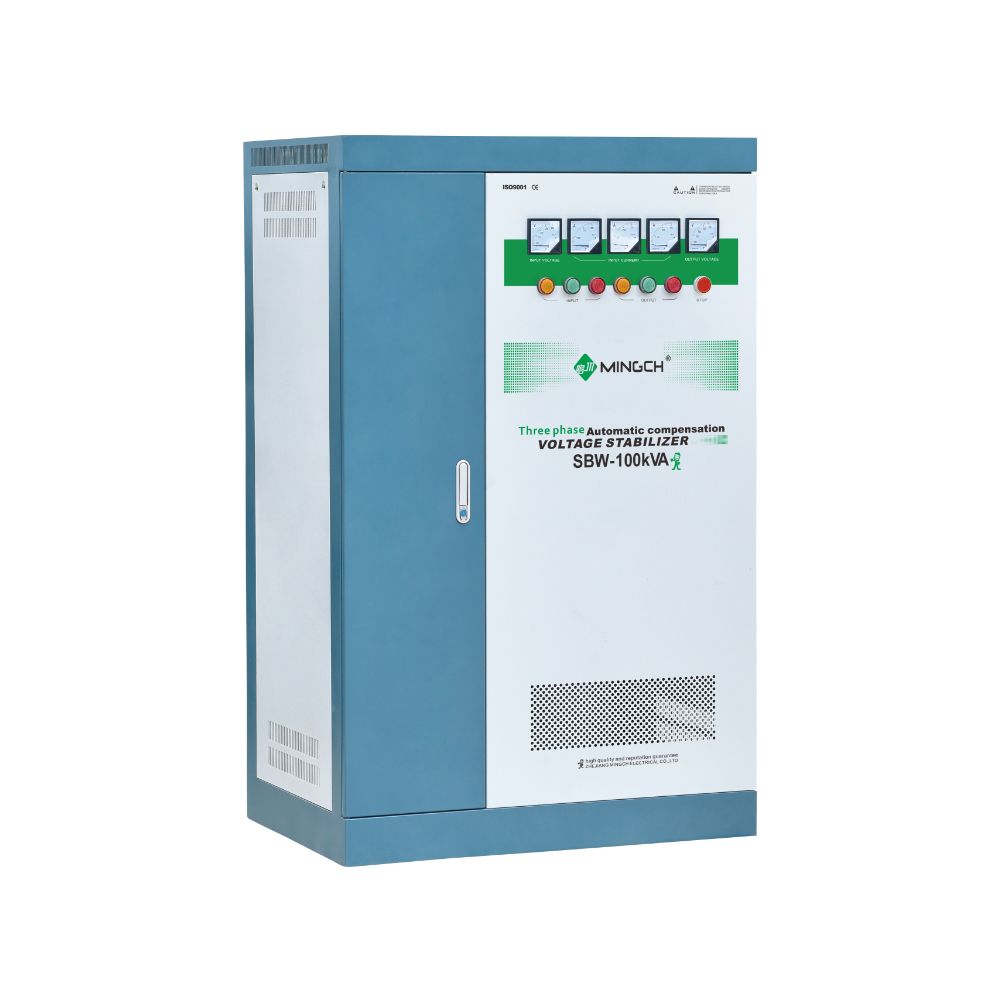
SBW-100kVA Three Phase Automatic Compensation Voltage Regulator
- Designed for Heavy Industrial Loads
- High Precision & Large Power Capacity
Advantages Over Standard Transformers
Three winding varieties of transformers offer key benefits compared to using multiple separate transformers.
- Cost and space efficiency: Instead of installing separate transformers for different voltage levels, one transformer handles multiple loads efficiently.
- Improved power quality: The tertiary winding compensates for unbalanced loads that would otherwise create voltage distortion. This is valuable in systems with significant single-phase loads like lighting or office equipment.
- Better voltage control: The tertiary winding provides connection points for capacitors or synchronous condensers. This helps maintain voltage levels and improves power factor without requiring separate compensation equipment.
Design Considerations
Manufacturers must carefully balance several factors when designing these transformers.
kVA Rating Balance
The kVA ratings of the three windings are typically unequal because each serves a different purpose. However, they must be coordinated to avoid overloading the core or creating excessive losses.
Core and Cooling Design
The core must handle the combined magnetizing requirements without saturation while minimizing losses. Cooling requirements increase because three windings generate more heat than two. Larger transformers use oil circulation and radiator fins, while smaller units may rely on natural air convection.
MINGCH optimizes winding placement and insulation to minimize impedance while maintaining adequate protection. With 30+ years of experience, their units operate reliably from -10°C to +40°C in harsh industrial environments.
Frequently Asked Questions
1.What is the difference between a 2 winding and 3 winding transformer?
A 2-winding transformer has only primary and secondary windings, while a 3-winding transformer adds a tertiary winding that provides an additional voltage level and helps balance loads and suppress harmonics.
2.What are the advantages of 3 winding transformers?
The main advantages include multiple voltage outputs from one unit, improved load balancing, harmonic suppression through delta-connected tertiary, and more economical construction compared to using multiple separate transformers.
3.What is the purpose of a third winding in a three-winding transformer?
The third winding supplies auxiliary equipment at a different voltage, balances unequal loads, suppresses harmonics, provides connection points for reactive power compensation, and enables earth fault protection through low impedance to zero-sequence currents.
Conclusion
Three winding transformer variants provide flexibility that standard transformers cannot match. The tertiary winding enables multiple voltage outputs, improves power quality, and simplifies system design. Whether you need auxiliary power supplies, voltage regulation, or harmonic control, the three winding transformer offers an efficient solution for complex electrical systems.
Discover MINGCH Manufacturing Excellence
Step inside our factory to see how high-quality voltage regulators and inverters are engineered for precision and durability.
Explore Our Factory


