




You can calculate three-phase voltage by looking at the link between line voltage and phase voltage. Line voltage, or V_LL, equals √3 times the phase voltage, V_ph. √3 is about 1.732. It comes from how the three currents sit 120 degrees apart. That angle changes how the whole system behaves.

What Is Three-Phase Voltage?
Three-phase voltage uses three alternating currents. Each one is shifted 120 degrees. It means the power moves in a steady rhythm instead of rising and falling like single-phase systems do. When you look at single-phase voltage, you only get one current. And that can feel less stable in comparison.
Three-phase setups give you real advantages. The load spreads out across the phases, and that can keep your equipment safer. You also get smoother performance because the system doesn’t “pause” between cycles. Another thing you’ll notice is better efficiency, especially when you’re running long lines.
Line Voltage vs Phase Voltage
Two measurements matter in 3 phase electrical calculations:
- Line Voltage (V_LL) is the voltage between two phases. If you measure between any two conductors, you get this value. You need this to determine what equipment can handle.
- Phase Voltage (V_ph) is the voltage between one phase and neutral. It’s also called line-to-neutral voltage. If you know this value, you can check voltage levels at individual loads.
In a balanced system, line voltage is always 1.732 times phase voltage. This comes from the 120-degree spacing between phases.
The Formula for Three Phase Power Calculation
The formula for three phase voltage calculation gives you the total power:
P_total = √3 × V_LL × I_L × cos(θ)
Here’s what each part means:
- P_total is total power in watts or kilowatts
- V_LL is line-to-line voltage
- I_L is line current
- cos(θ) is the power factor
If you have a resistive load only, the power factor is 1. That means the formula becomes P = V × I × √3. Say you have a 120-volt circuit with 20 amps per phase. You calculate 120 V × 20 A × 1.732 = 4,157 watts.
How to Calculate Line Voltage
You can calculate line voltage if you know phase voltage:
V_LL = √3 × V_ph
This shows line voltage is 1.732 times higher than phase voltage. The √3 comes from how the three phases add together geometrically. Say your phase voltage is 277 volts. Multiply 277 V × 1.732 to get approximately 480 volts line voltage. This is common in commercial buildings.
How to Calculate Phase Voltage
If you know line voltage, you can find phase voltage:
V_ph = V_LL / √3
Say you have 480 volts line-to-line. Divide 480 volts by 1.732. You get approximately 277 volts. This is the voltage between any phase and neutral.
Our article titled What is three phase voltage regulator and how does it work explains how these devices keep voltage stable. Voltage regulators automatically adjust their output when the input voltage varies, protecting your equipment from voltage-related damage.
Three Phase AC Power Calculation Types
Three phase AC power calculation includes several power types:
- Total Power (P_total) is the overall power in the system. It combines real power and reactive power. Use P_total = √3 × V_LL × I_L × cos(θ) to calculate it.
- Apparent Power (S) adds active and reactive power as vectors. Calculate it as S = √3 × V_LL × I_L. You measure this in volt-amperes (VA) or kilovolt-amperes (kVA). It shows total system capacity.
- Active Power (P) is the real power that does useful work. Motors and heaters use this power. Calculate it as P = S × cos(θ). You measure it in watts (W) or kilowatts (kW).
- Reactive Power (Q) doesn’t do useful work directly. It maintains voltage levels and magnetic fields in motors. Calculate it as Q = S × sin(θ). You measure it in volt-amperes reactive (VAr).
Using a 3 Phase Power Calculator
A 3 phase power calculator makes calculations faster. You input line voltage, line current, and power factor. The calculator gives you all power values automatically.
Here’s an example with 480 volts, 50 amperes, and a 30-degree phase angle:
- Total power: √3 × 480 V × 50 A × cos(30°) ≈ 41,575 watts
- Apparent power: √3 × 480 V × 50 A ≈ 41,575 VA
- Active power: 41,575 VA × cos(30°) ≈ 35,991 watts
- Reactive power: 41,575 VA × sin(30°) ≈ 20,787 VAr
These calculations are essential for designing and optimizing power distribution systems. The function of three-phase voltage regulators becomes clear when you see how voltage variations affect these power calculations.
Calculating Load Balance
Load balancing spreads power evenly across phases. This reduces losses and protects equipment. Here’s the process:
Step 1: Measure each phase load Measure Phase A (P_A), Phase B (P_B), and Phase C (P_C). Use kilowatts or kilovolt-amperes.
Step 2: Find total and average Add all three: P_total = P_A + P_B + P_C. Then divide by 3 for average: P_avg = P_total / 3.
Step 3: Find each imbalance Subtract average from each phase:
- Imbalance_A = P_A – P_avg
- Imbalance_B = P_B – P_avg
- Imbalance_C = P_C – P_avg
Step 4: Calculate percent imbalance For each phase: Percent Imbalance = |Imbalance| / P_avg × 100%
If your imbalance goes over 5-10%, redistribute loads. High imbalance causes losses, heat, and equipment damage. Different types of regulators can help manage imbalanced systems, though proper load distribution works best.
Example of Three Phase Voltage Calculation
Let’s use real numbers. Say Phase A has 30 kW, Phase B has 45 kW, and Phase C has 25 kW.
- Total load: P_total = 30 + 45 + 25 = 100 kW
- Average load: P_avg = 100 / 3 ≈ 33.33 kW
Imbalances:
- Imbalance_A = 30 – 33.33 = -3.33 kW
- Imbalance_B = 45 – 33.33 = 11.67 kW
- Imbalance_C = 25 – 33.33 = -8.33 kW
Percent imbalances:
- Phase A: |-3.33| / 33.33 × 100% ≈ 10%
- Phase B: |11.67| / 33.33 × 100% ≈ 35%
- Phase C: |-8.33| / 33.33 × 100% ≈ 25%
This system shows a significant imbalance, especially on Phase B. You would need to redistribute some load from Phase B to the other phases. 3 phase power advantages include efficiency and reliability, but only when the system stays balanced.
Common Three Phase Voltage Calculation Mistakes
People often mix up line voltage and phase voltage. Line voltage measures between two conductors. Phase voltage measures between one conductor and neutral. In balanced systems, line voltage always equals √3 times phase voltage.
Another mistake is skipping the power factor. If you forget cos(θ), you’ll get the wrong active power value. Always include it in your calculations.
Check your units every time. Voltage should be in volts. Current should be in amperes. Power should be in watts or kilowatts. If you mix units, your answer will be wrong. Also, make sure you’re using the right formula for balanced or unbalanced systems.
Voltage Regulation Equipment
Maintaining stable three-phase voltage requires proper voltage regulation equipment. MINGCH’s TNS series three-phase automatic AC voltage regulators provide stable 380V output with efficiency above 95%. These units handle capacities from 15kVA to 600kVA, so they cover a wide range of industrial applications.
The choice between 3 phase automatic voltage regulator vs manual one depends on your application requirements. Automatic regulators adjust output voltage continuously without operator intervention. This maintains stable voltage even when input voltage varies or loads change.
MINGCH manufactures automatic voltage regulator units in-house, which provides better quality control and faster customization. Their units operate in ambient temperatures from -10°C to +40°C, so they work well in harsh industrial environments.
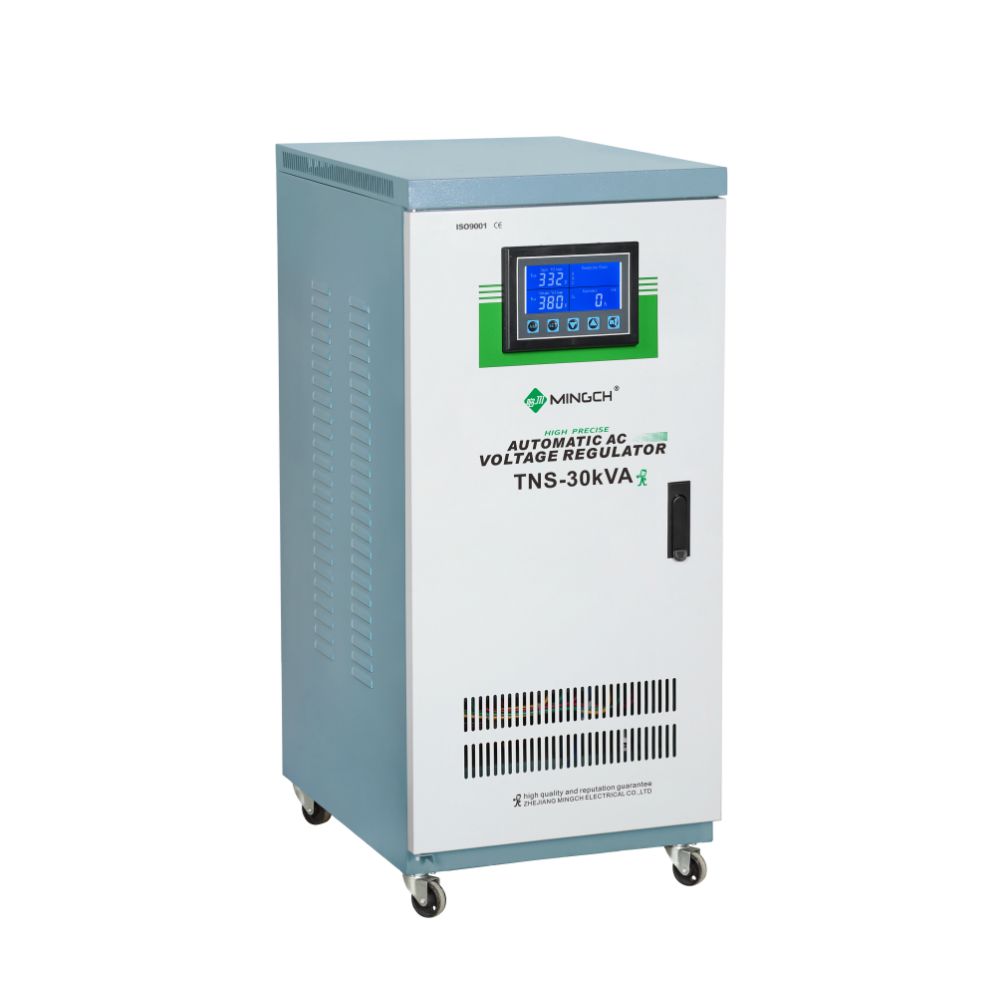
TNS-30kVA High Precise Three Phase Automatic AC Voltage Regulator
- Automatic Servo Motor Control
- Stable Voltage for Industrial Use
Conclusion
Now you know how to do 3 phase voltage calculation. You can size equipment correctly and keep systems balanced. Start by measuring your voltage levels. Calculate how loads distribute across phases. If you see imbalance or unstable voltage, add automatic regulation.
MINGCH offers custom three-phase solutions with monitoring built in. They have 30+ years of experience. They can help you pick the right equipment for your application.
Discover MINGCH Manufacturing Excellence
Step inside our factory to see how high-quality voltage regulators and inverters are engineered for precision and durability.
Explore Our Factory


